
Agile Digital Twins
One governed spatial foundation
Modules deployed as required
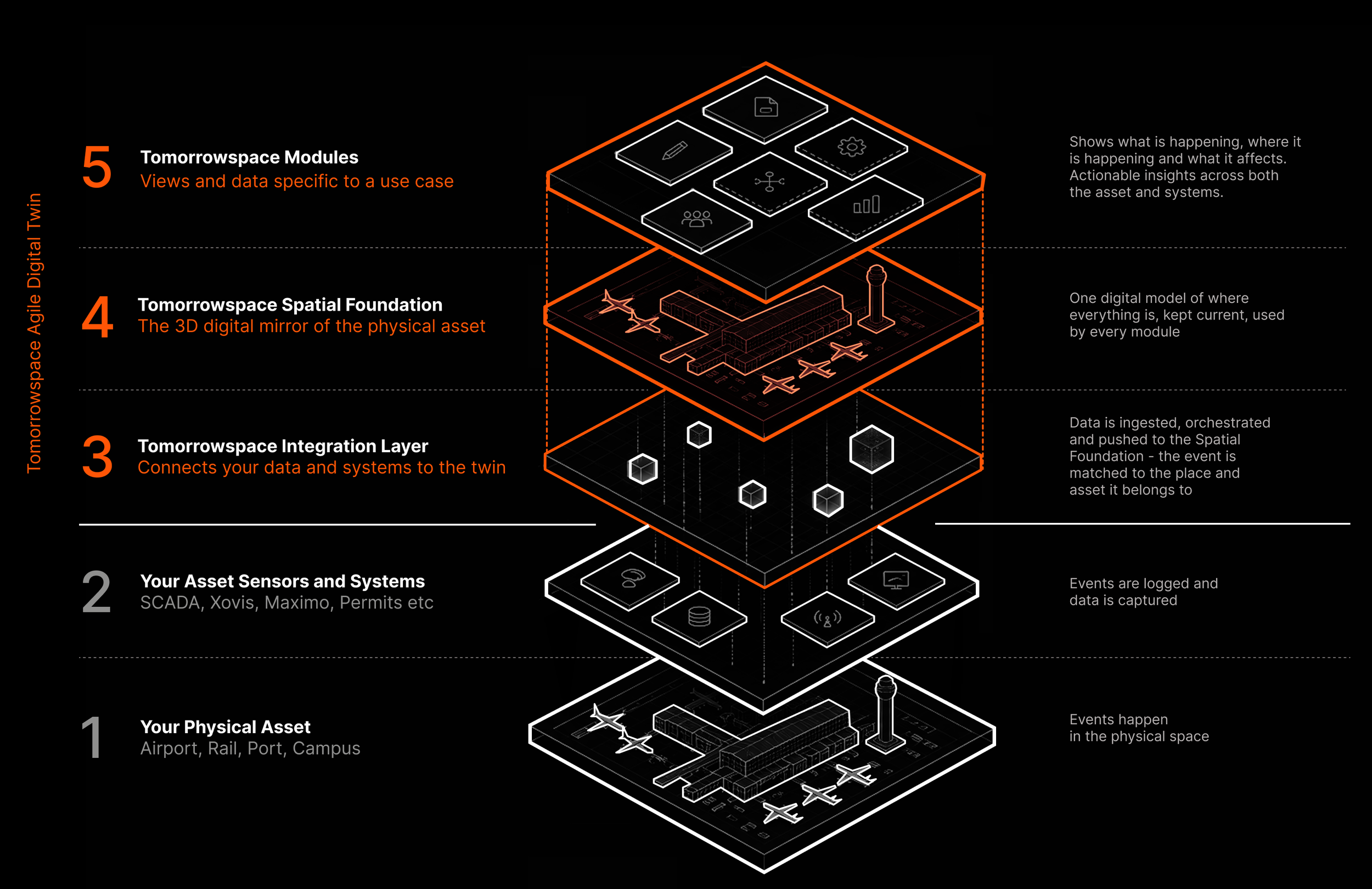
Agile Digital Twin: the five layers
The Agile Digital Twin
An Agile Digital Twin is built on a single governed spatial foundation — a precise, authoritative representation of the asset that remains current across its full lifecycle, from design through construction and into operations.
Modules are deployed on that foundation as operational requirements are proven. Each module addresses a specific use case: a permit workflow, a possessions calendar, a works coordination layer. The foundation does not change when a new module is added. The twin grows without rebuilding.
This approach delivers operational value from the first module deployed and scales with the organisation as requirements evolve — without the deferred value and adoption risk of a full-build programme.
Modules
Each Tomorrowspace module serves one use case, deployed on the same governed spatial foundation — showing what's happening, where it's happening, and what it affects.
Modules can be added as required — and a single Agile Digital Twin can carry multiple modules, each accessed through defined user groups to suit different audiences and stakeholders.
Where a project has operational, spatial or governance requirements the standard modules don't yet address, a new module is defined the same way as every other — against a named need, on the same foundation, to the same standard.
-
For project teams, client stakeholders and design leads.
A governed design environment for team and stakeholder review. Accessible from anywhere, on any device — communicating options, phasing, programme information and supporting 3D markup from one authoritative spatial reference across the project lifecycle. -
For permit coordinators, works supervisors and HSE teams.
Spatial management of active permits across a live asset — every permit issued, tracked and closed against a single authoritative spatial reference. -
For project managers, operations leads and site coordination teams.
Spatial management of active permits across a live asset — every permit issued, tracked and closed against a single authoritative spatial reference. -
For network operations, engineering access and works planning teams.
Spatial coordination of network or asset possessions — access requirements, isolations and concurrent works made visible before they become conflicts. -
For operations, planning and safety teams.
Live occupancy and movement within the governed spatial environment. Counting systems and sensors provide the data; the twin places it — showing how people move through terminals, stations and spaces, and how a closure, works zone or live permit changes that movement.
-
For development and sales teams, agents and prospective occupants.
Asset sales and pre-completion engagement in a governed spatial environment — prospective occupants and investors navigating the asset in its designed or built state.
Built to last
Our spatial foundations are developed in alignment with ISO 19650 — the international standard for information management across the lifecycle of a built asset. This ensures the twin remains authoritative, auditable and transferable, and that the information it holds meets the requirements of public sector procurement and enterprise governance frameworks.
A twin is only as valuable as the trust placed in it. That trust is maintained through custodianship — the ongoing responsibility for keeping the spatial foundation current, governed and aligned to the asset as it changes.
Tomorrowspace can act as custodian for the twins we build. Assets change — through construction, refurbishment, operational evolution and programme shifts. Custodianship keeps the digital aligned to the physical through that change — maintaining the foundation, controlling how it is accessed and issued, and ensuring the standard is held across every module deployed on it.
Custodianship is available as a low-friction ongoing arrangement — a simple retainer that keeps the twin authoritative and the relationship active, without the overhead of a formal programme. The twin does not degrade at handover because the relationship does not end at delivery.
One spatial foundation.
Any module.
The life of the asset.
Contact Us
If you're working on a major asset or responsible for a complex infrastructure project and want to understand how an Agile Digital Twin could help, we'd like to hear from you.
The best starting point is a demonstration — thirty minutes with a live twin around your asset type.