

Tomorrowspace
Perspectives
Perspectives is where Tomorrowspace speculates, shares ideas, research and practical insights on Digital Twins and the future of communicating complex projects.
Explore articles covering airports, transport, BIM, GIS, Unreal Engine, AI and the technologies shaping the built environment.

Sept 26 |
Autodesk Authorised Developer
Posted by Troy Hodgson
Tomorrowspace is now an Autodesk Authorised developer.
We have worked hard building the pipeline and tools that take BIM models and their information through into our twins, so that key asset and relational data is retained, matched to the geometry it belongs to, and queryable wherever maintenance and operational processes require. During design stage Twins, the same pipeline means models can be updated, swapped out and maintained with little rework.
This work further strengthens our Agile Digital Twin framework, which rests on one persistent, governed spatial foundation.
If you are running a digital twin programme and would like to see how this works, we would be glad to arrange a demonstration.

Sept 26 |
The Temporal Twin
Posted by Troy Hodgson
Digital twins are steadily entering the mainstream of smart city planning, but current deployments represent only the earliest iteration of a much larger transition.
The digital twin of the future will abandon our current definition of a smart platform and will instead function as a continuous 4D temporal memory for metropolitan areas. By synthesizing AI and multi-source streams — including high-frequency IoT sensors, structural models, and continuous egocentric visual feeds harvested from wearable devices — future twins will establish an absolute spatial and historical record of the city. They will operate as persistent memory and predictive instrument containing all recorded data, allowing systems to query any past or future state of the built environment along a unified timeline.
Beyond retrospective auditing, the integration of real-time sensory data into colossal predictive simulation engines will fundamentally redefine municipal governance: holding not just every past state and data point, but every possible future trajectory across all possible municipal decisions. By continuously processing billions of behavioral vectors and environmental metrics, urban twins will execute real-time probabilistic simulations of human movement and infrastructural stress fractions before they physically manifest.
Automated traffic modulation, adaptive transit capacity allocation, and preemptive emergency deployment will demonstrate a permanent shift from reactive crisis management to autonomous, anticipatory systems control, where the city already knows what is coming and governs itself before events occur.
This shift will reshape daily existence into a seamless experience of frictionless environments, functioning as an active enterprise spatial layer that writes back to physical infrastructure. Commuters will step out of their doors into transport networks and traffic grids that have already self-optimized to dissolve bottlenecks before they form. Citizens will move through public spaces insulated by invisible layers of safety, where emergency medical responses, crowd-control protocols, and infrastructure repairs deploy autonomously ahead of incidents. Micro-climates and weather extremes will be counteracted automatically by adaptive street systems and building envelopes, with municipal cooling systems that trigger before individuals even feel a shift in temperature, entirely redefining how we inhabit and experience the modern metropolis.
By 2050, preemptive grid-load rebalancing, autonomous structural remediation, and dynamic subterranean zoning will not be remarkable; it will be expected. The true horizon of this transformation will be powered by artificial intelligence, shifting the foundational question from technical capability to control. Ultimately, the future belongs to those who own the intelligence layer — because whoever owns the AI will own the city’s brain, and temporal memory.
March 26 |
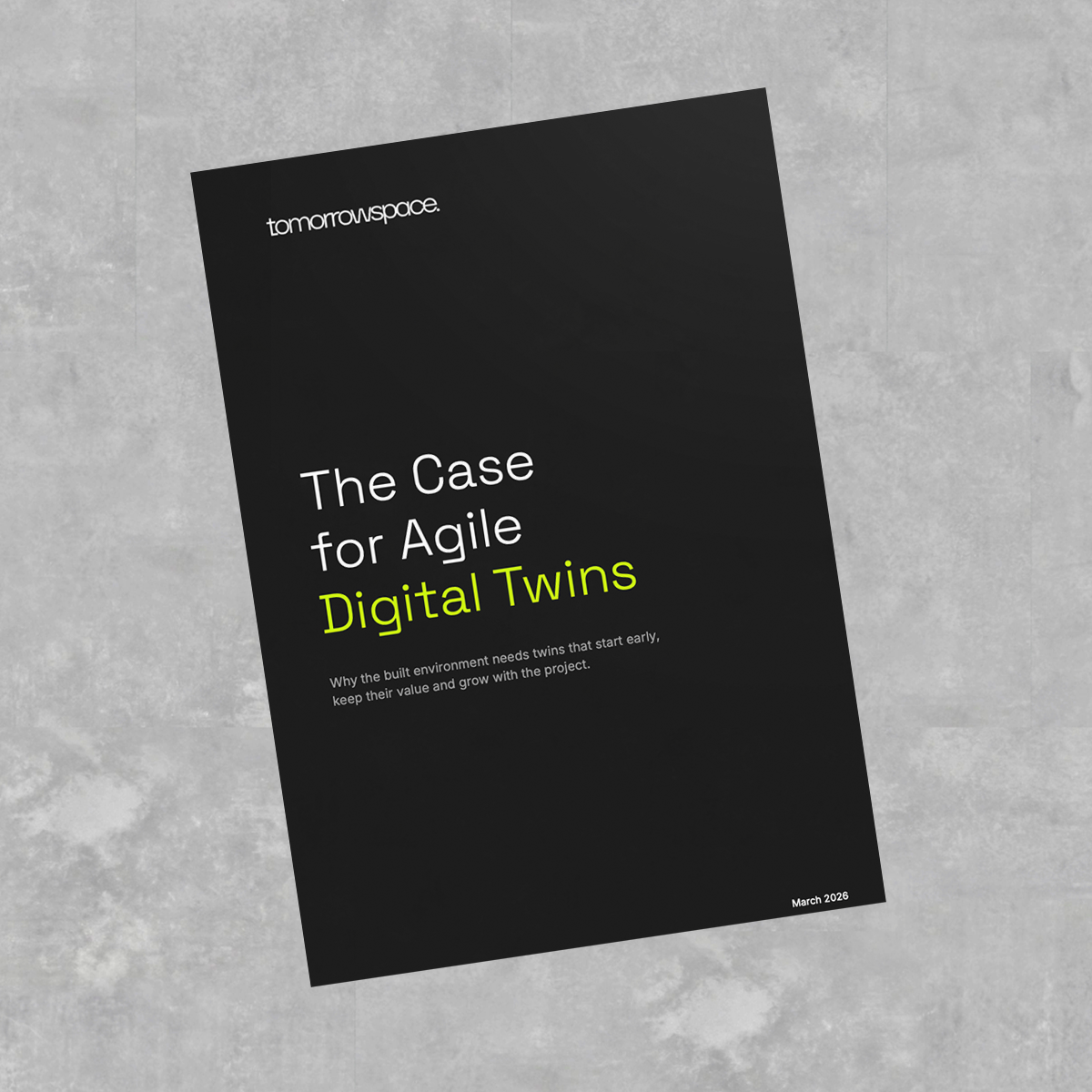
Tomorrowspace White Paper
The digital twin has a definition problem. The term means something different to nearly everyone who uses it, and the confusion is holding the industry back. Vendors push enterprise platforms that require massive upfront investment. Clients hesitate because the entry cost is too high and the value too distant. Meanwhile, the phases where digital twins could deliver the most impact - design, stakeholder alignment, early decision-making are ignored entirely. We wrote this white paper to propose a different approach.
The paper introduces the concept of the 'Agile Twin': a Spatial digital twin designed to be useful across every phase of an asset's lifecycle, deployed in modular increments aligned to business outcomes rather than delivered as a single, comprehensive platform. It covers three core principles:
1. Start at concept, not at handover.
2. The most consequential decisions on any project happen during design.
3. Build in modules, not monoliths.
Download the white paper (PDF)
25.03.26 | Digital Twins
Eight Stages, Why Most Fail Before Stage Three
Harvard and NUS's CITYSTEPS model maps eight stages of digital twin maturity. Most twins stall at Stage 3. Most vendor pitches start at Stage 7. The gap in between is where projects fail — and where the real work lives.
Read on LinkedIn →

11.03.26 | Dubai Law No. (3) of 2026
Twin as your service history asset?
Every building in Dubai now requires a Quality and Safety Certificate. For developers and operators, this creates a compelling reason to adopt a digital twin early.

26.02.26 | Land and Expand
The Case for Starting Small with Digital Twins
Most digital twin programmes fail not from lack of ambition, but from a failure to prove value quickly enough. The surest path: prove ROI first — expansion follows naturally.

16.02.26 | Digital Twin Dubai 2026
Seven Reoccurring Themes
Across two days of talks, the same truths surfaced repeatedly: a twin is a process, not a delivered asset. Define the problem first. Start small. Build flexibility in from the outset. The industry is converging on these principles — here's the full list.
Read on LinkedIn →
22.01.26 |Dubai 2040
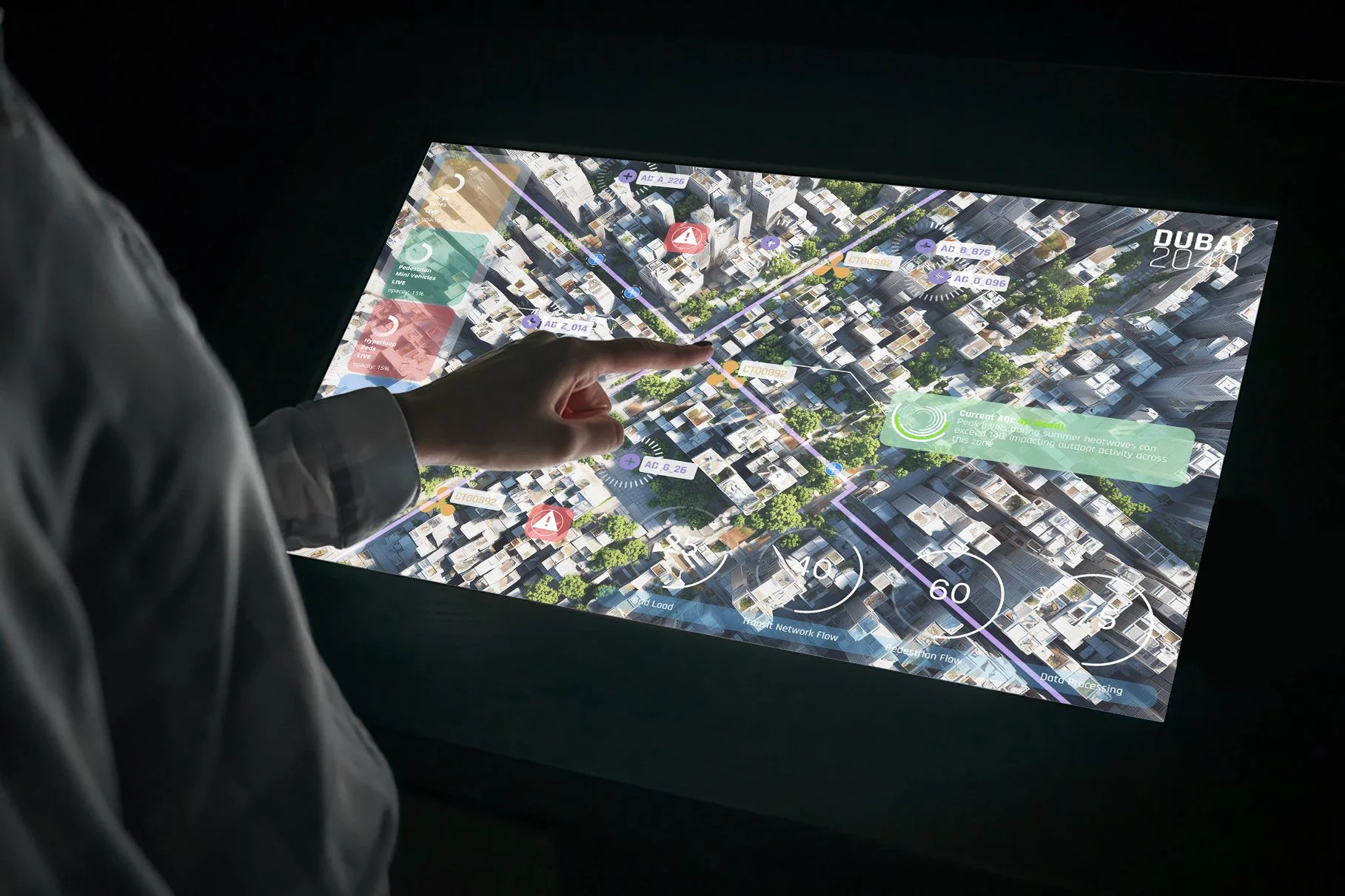
Where Top-Down Meets Ground-Up
Dubai's 2040 masterplan envisions a smart '20-minute city', but a city can only be as agile as its data architecture. The real challenge is bridging the orchestration layer with building-level operational truth.
06.02.26 | Lightweight Twins
A Practical Guide to Digital Twins in Practice
The biggest misconception about digital twins is that they require a massive technical overhaul from day one. They don't. Here are seven practical steps for practices ready to begin…